How to efficiently machine shaped parts on CNC mill-turn machines?


CNC lathes and milling machines are currently the most widely used equipment in small and medium-sized enterprises.Conventional CNC lathes are primarily used for machining rotary parts such as shafts and discs.
CNC milling machines feature a rotary table on the worktable, enabling selective milling of shaft components.
Due to their long length and small diameter, gear shaft parts present significant machining challenges on lathes.
Gear shafts are mechanical components primarily used for transmitting power or torque.
Efficient machining processes not only enhance the surface quality of shaft workpieces but also improve dimensional and geometric tolerances.
This paper focuses on turning shaft components, followed by milling the gear sections using a four-axis machine tool.
Modern machine tools offer increasingly advanced functionality and precision, demanding higher quality standards for machined products.
Shaft components are among the most common in industry.
Due to their structural characteristics, shafts are prone to deformation and bending during machining.
In recent years, numerous scholars have analyzed machining processes for slender shafts.
Zhao Jinwei investigated CNC lathe machining of slender shafts, proposing suitable clamping methods and processing techniques.
Gong Shuhong developed an analytical deformation model for slender shafts under cutting forces through research.
Zhang Mingyan established different clamping methods—one clamp and one center versus two centers—for machining long shaft components, employing finite element analysis for slender shafts.
This paper investigates gear shaft machining processes using a four-station CNC lathe and a four-axis CNC milling machine.
During turning operations, a two-center reverse-tooling and reverse-feed technique ensures gear shaft coaxiality.
For finishing, segmented single-end finishing compensates for dimensional errors caused by machine tool lead screw backlash, thereby reducing machining steps.
The material for this gear shaft, 20CrMnTi, is a high-performance carburizing steel characterized by high hardenability and excellent mechanical properties.
The mechanical properties of 20CrMnTi are as follows:
Tensile strength (σb) ≥ 1080 MPa; Yield strength (σs) ≥ 835 MPa.
It ensures hardenability while exhibiting particularly high low-temperature impact toughness.
20CrMnTi is a steel for surface carburizing and hardening.
It exhibits good machinability with minimal deformation during processing and possesses excellent fatigue resistance.
Primary applications include shaft components, piston parts, and various specialized automotive and aerospace components requiring superior wear resistance and fatigue endurance, suitable for heavy-duty or high-speed transmission systems.
Blank dimensions: Φ45×150 mm. Both ends feature center holes.
Left and right stepped shafts mount gears respectively. Surface roughness requirement: Ra 1.6.
Tight dimensional tolerances with coaxiality tolerance of 0.025 mm.
Right end has M12x6g thread. For the gear section: – Module: 2 – Number of teeth: 15 – Pressure angle: 20°.
Detailed structural dimensions are shown in Figure 1.
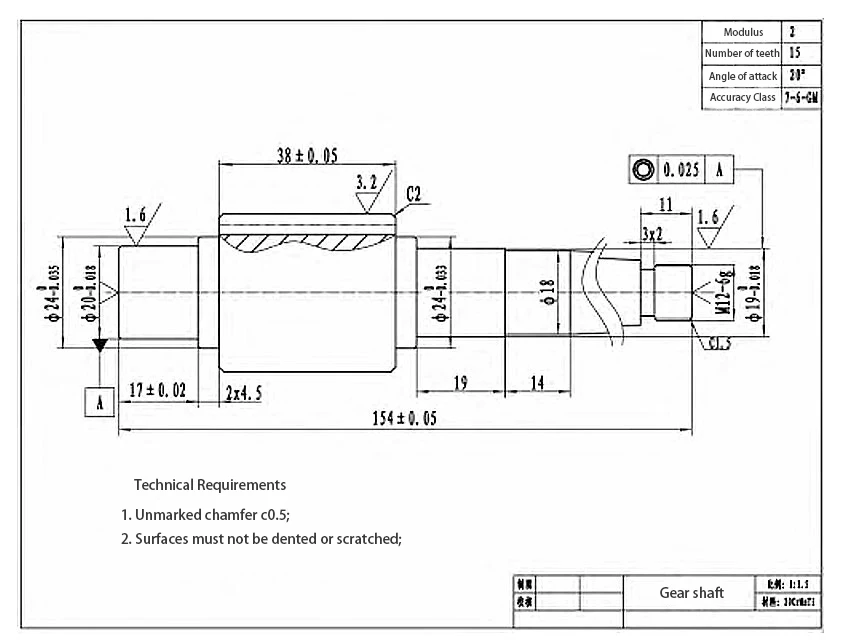
This component is a typical shaft part requiring high dimensional accuracy.
The dimensional tolerance for both left and right bearing seats is 0.018 mm; the coaxiality requirement for both bearing seats is 0.025 mm.
During turning, machinists employ a dual-center method to ensure shaft coaxiality.
When machining the left bearing seat, reverse-angle roughing followed by reverse-angle finishing is used.
For thread machining, an extended-reach thread turning tool is employed.
Because the material is highly hard, machinists divide thread turning into 10 passes to prevent thread chipping and deformation.
For rough turning, a smaller cutting depth and higher linear speed were selected.
Machinists used cubic boron nitride (CBN) inserts for high-speed, slow-feed finishing to achieve the required surface roughness of Ra 1.6.
Table 1 presents the machining process card.
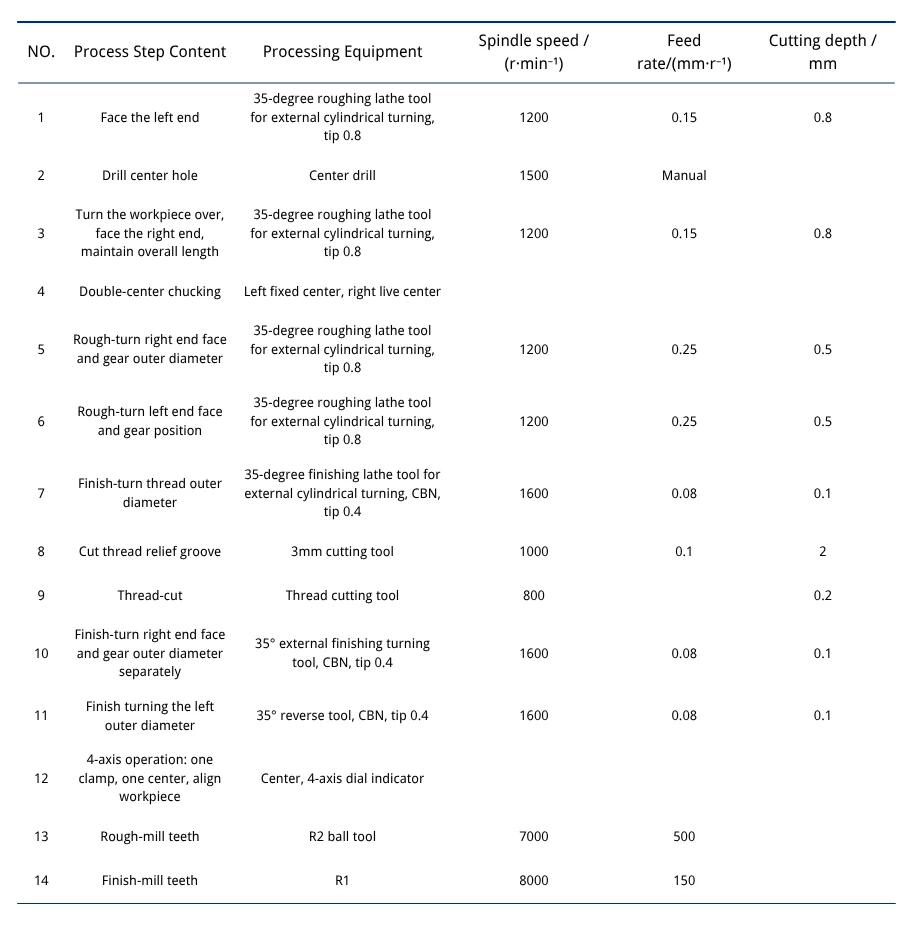
A combination of manual and automatic programming is employed.
Automatic programming utilizes Mastercam 2024, which features robust modeling capabilities, diverse machining strategies, and reliable toolpath simulation.
During tool and blank setup, the dimensions match the actual tool size, ensuring error-free machining and collision avoidance.
Figure 2 illustrates the programming for finishing the left-end diameter of the shaft using a 35-degree reverse tool, with the toolpath simulation shown in Figure 2.
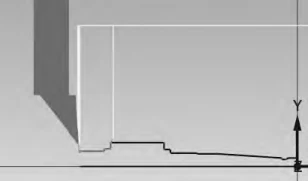
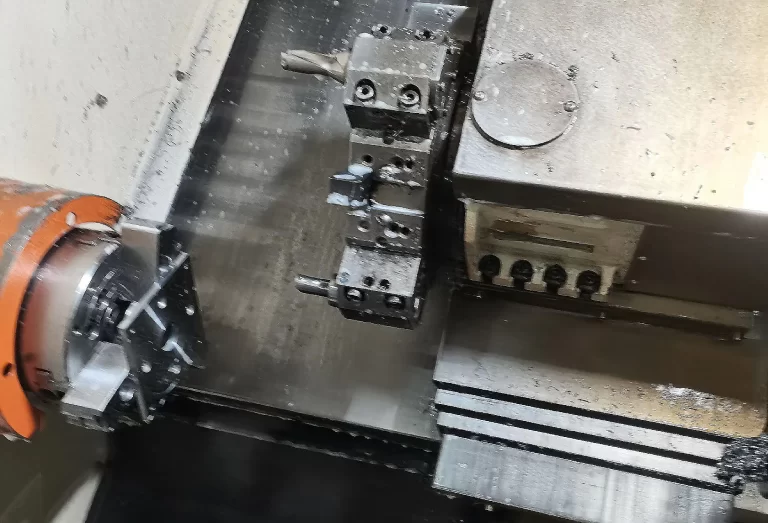
Machinists use the Chenbang Machine Tool CK6150 (Huazhong 818A system) with a four-station front tool holder to machine the part during turning operations.
The process begins with rough turning of the right-end diameter and left-end diameter, followed by finish turning of the thread diameter and cutting the thread relief groove.
Next, the thread is turned, concluding with final finish turning.
Machinists clamp the workpiece as tightly as possible during thread turning to prevent deformation caused by excessive cutting forces and minimize movement during machining.
Given the material’s high hardness, shallow cutting depths (0.5 mm per side) are selected.
During finishing, machinists machine each step dimension separately to ensure dimensional accuracy. Figure 3 illustrates the machining process.
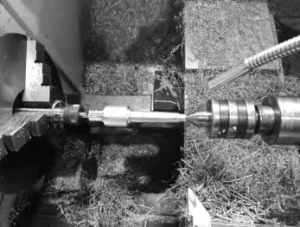
Gear shafts establish power transmission chains by meshing with gears, transferring motion and torque to other mechanical components.
They efficiently transmit input power to the output end, ensuring the normal operation of mechanical systems.
Key Advantages of Gear Shafts Over Separate Shafts, Gears, and Keys – Integrated shaft-gear construction provides high rigidity, low noise during transmission, and simplified installation.
As a core component of gear drives, gear shafts support gears, enable torque amplification through gear ratio adjustments, and function as part of balancing mechanisms.
Disadvantages include multiple machining steps, extended processing times, and high manufacturing complexity.
Using NX2412 for modeling, analyze the drawings and review relevant gear parameters.
Employ the “Cylindrical Gear” command within the software’s GC Toolbox to complete the gear shaft modeling.
Analysis of the model indicates a minimum root radius R0.75 at the gear root base.
Machinists performed rough machining with an R2 ball-nose cutter and then finished the tooth surfaces with an R1 ball-nose cutter.
Machinists manually ground the tooth surfaces with sandpaper to complete the gear shaft processing.
Figure 4 shows the software-generated model of the gear shaft.
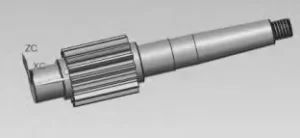
Establish the programming coordinate system. Create R2 and RI ball cutters.
Define the blank based on the tooth section. Plot isoparametric curves at the root bottom, parallel to the axis direction, to serve as programming guide lines.
Employ Variable Contour Milling [ARIABLE-CONTOUR].
Variable contour milling is the fundamental variable-axis surface contour milling for components or cutting zones featuring diverse drive methods, spatial ranges, cutting modes, and tool axes.
Drive Method: Select “Curve/Point,” choose the curve at the tooth root base as the drive geometry, with a component allowance of 0.1mm; Tool axis: Select “Perpendicular to part”; “Multiple allowance offset” set to 3mm; “Increment” 0.5mm.
Set linear approach/retract type; Spindle speed 7,000 rpm; Feed rate 200 mm/min to generate toolpath.
Transform the generated path using “Rotate around straight line” with a rotation angle of 24°, creating 15 associated copies.
Array replicate the generated path by selecting all paths, post-process, and generate a program. Figure 5 shows the tooth roughing path.
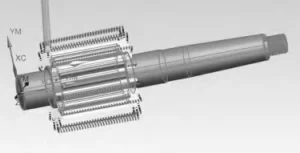
Employ variable contour milling using an R2 ball-end mill to finish the upper tooth surfaces.
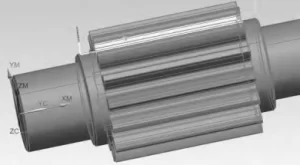
Select “Surface Area” as the drive method; set “Cutting Mode” to reciprocating with ‘Quantity’ at 20; configure the tool axis as “Away from Straight Line” with a 0mm allowance to generate the toolpath.
Transform the generated path using “Rotate around straight line” with a rotation angle of 24° and 15 associated copies.
Figure 6 shows the tooth surface finishing path.
Similarly, perform finishing operations on the right side of the gear tooth surface.
Use variable contour milling. Select “Curve/Point” as the drive method.
Choose the curve at the bottom of the tooth root as the drive geometry.
Set part allowance to 0. Select “Perpendicular to Part” for the tool axis.
Multiple Allowance Offset“ set to 1mm; ”Increment” 0.25mm.
Set linear infeed and outfeed type: Spindle speed 8000 rpm; Feed rate 200 mm/min. Generate toolpath.
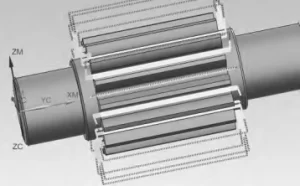
Transform the generated path using “Rotate around straight line” with a rotation angle of 24°, creating 15 associated copies.
Figure 7 shows the tooth root bottom machining path.
Machinists machined the gear shaft using a Neway VM-1050S four-axis machine tool.
This four-axis milling machine incorporates a rotary axis mounted on the worktable, rotating around the X-axis and defined as the A-axis.
Machinists used a clamp-and-center setup during clamping.
Machinists used a dial indicator to locate the highest point of the gear, then aligned the workpiece by moving it left and right with a copper hammer.
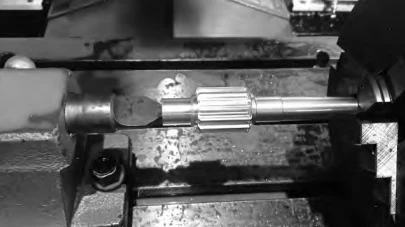
The program is run to perform machining. The machined gear shaft exhibits surface waviness on the tooth profile.
After manual polishing and grinding, it passes assembly and operational testing, as shown in Figure 8.
This paper systematically investigates the machining process and programming methods for 20CrMnTi gear shafts through a combination of theoretical analysis and practical application, achieving the following key results:
The application of a two-center reverse-cutting process successfully met the 0.025 mm concentricity tolerance requirement.
Actual machining data indicates that radial runout errors remained stable within 0.01 mm during dual-setup machining, demonstrating improved efficiency and precision compared to traditional setup methods.
The CBN insert combined with finishing parameters (1600 r/min, feed rate 0.08 mm/r) achieved a surface roughness Ra value of 1.2–1.4 μm.
Dimensional tolerances were met in the first setup, eliminating the secondary grinding step required in conventional processes.
An innovative variable allowance layered machining method was applied in gear processing: – Roughing stage: 3mm total allowance removed in 6 layers (0.5mm per layer) followed by two 0.25 mm gradient cuts during finishing.
This effectively reduced tool load, extending ball-nose cutter life to 2.3 times that of conventional machining.
A dual-track composite programming strategy was developed: manual programming ensures basic contour machining efficiency, while automatic programming achieves precise control of complex surfaces (tooth profile error ≤ 0.03 mm).
The synergy of these two strategies shortens total programming time.
It should be noted that improvements are still needed in the following aspects during machining:
(1) Manual intervention during the gear polishing stage consumes a significant portion of total working hours.
It is recommended to develop a flexible grinding device to achieve automation.
(2) During four-axis simultaneous milling, the coolant flow path requires optimization to eliminate waviness.
(3) The tool wear monitoring system for 20CrMnTi carburized layer machining needs refinement.
Future work will focus on developing a digital twin-based intelligent process parameter optimization system to further enhance the automation level of gear shaft machining.